
With rising fuel prices and skyrocketing electricity bills, the idea of achieving full energy independence is becoming more and more attractive. And while complete freedom from fossil fuels might remain a challenge for another few years, homeowners across Ireland are still finding new ways to reduce their reliance on these sources.
From warming up their homes with improved insulation to installing a Solar PV system for lower electricity bills and greater energy efficiency, renewable energy sources are highlighting sustainable living – and a more affordable future.
Thinking of joining over 119,000 Irish homes that already have PV panels installed? Then you might be wondering if you can power your whole house with solar panels.
In this post, we’ll tackle that very question! We’ll also explore:
- The feasibility of solar independence: with a handy tool from the SEAI
- How many solar panels you might need on your roof
- Factors affecting solar panel performance, and their energy generation
- Smart grids: the future of solar in Ireland
- Other ways to improve energy efficiency at home
As you can see, we’ve plenty of (hopefully, interesting!) points to explore. So, let’s get started…
Solar independence and the SEAI calculator
Imagine complete energy independence. A world in which you’re saving tons on electricity bills, you’re not tied to the whims of a utility company and you’re contributing towards a much greener environment.
But is it possible to go completely “off-grid”…to remove your reliance on any energy source that you haven’t generated yourself? In short, kind of. But probably not right now.
While creating a home that’s 100% powered by solar energy is a lovely dream, for most of us, that simply won’t be the reality. (At least, not for another few years.)
Aside from initial installation costs (which, fortunately, are becoming cheaper with a range of government grants), there may also be legal and regulatory obstacles in your path towards complete energy independence. You’d also miss out on the Clean Export Guarantee, which allows you to sell excess electricity back to the grid.
As there’s so much to consider, a happy medium may be to stay connected – but to cover a large portion of your consumption with renewable energy sources. To that end, using solar to meet over 50% of your household’s energy needs is a very achievable goal.
How much energy do you use?
According to the SEAI (Sustainable Energy Authority of Ireland), a 3kW Solar PV system of around 20m² could generate 2,600 kWh of electricity per year: Which could cover between 40% – 60% of an average Irish household’s energy needs, based on a family-sized home (of 3 – 4 people). But of course, it depends on how much electricity your household consumes…and on your patterns of consumption, too.
To work out how much energy you use at home, take a look at your last few electricity bills. You should be able to get an idea of your average home energy consumption, use this to calculate your annual energy consumption and, in doing so, gain a greater understanding of a) how many solar panels you might need and b) the system size you should choose to cover a significant portion of your bills.
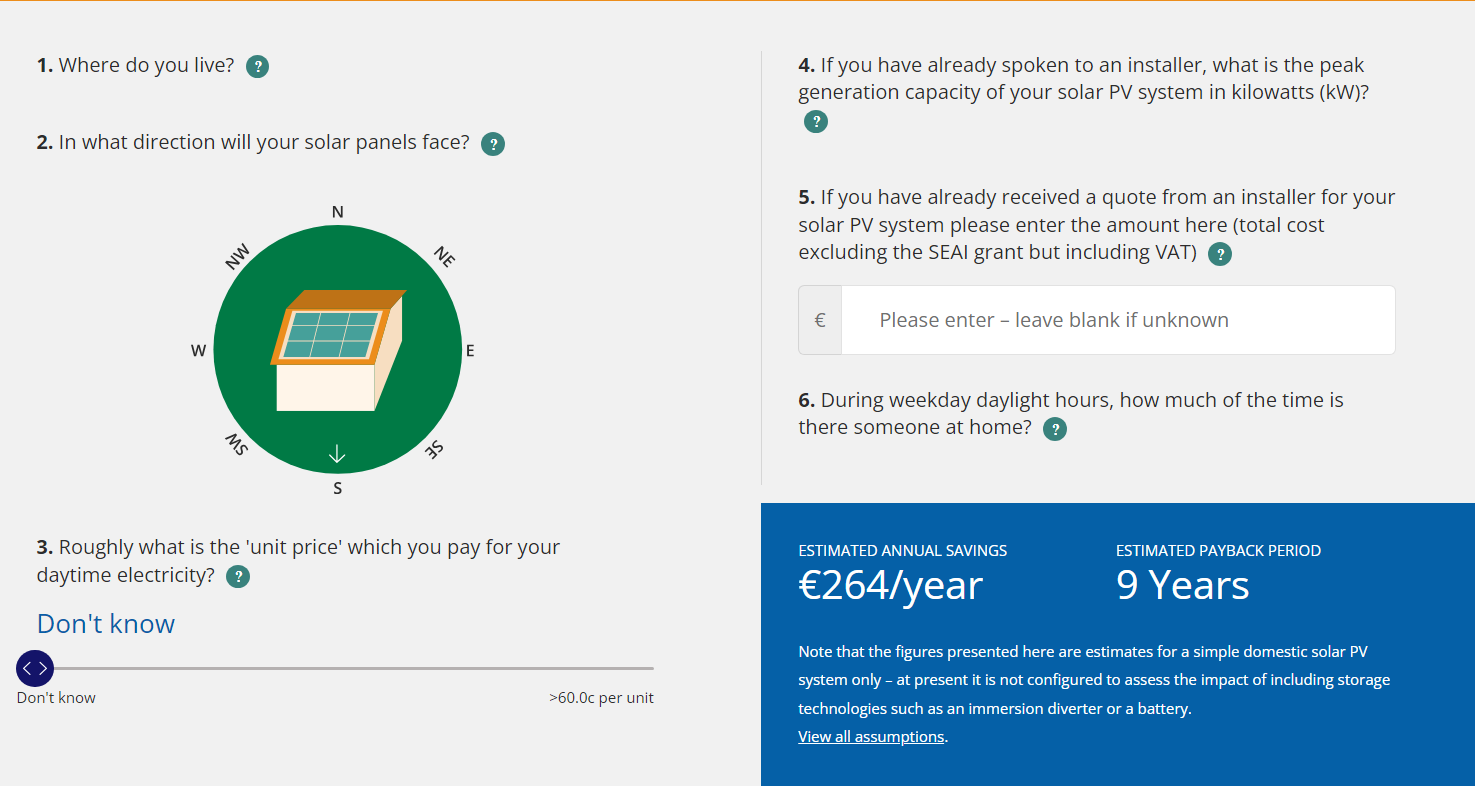
This solar calculator from the SEAI is a handy tool that helps you work out how much you could save on your electricity bills when you install solar panels, plus when you might see a return on your investment. Calculating your consumption is important in determining the feasibility of solar independence – because if you don’t know what you already use, you can’t know how much you’ll need solar to cover.
How many solar panels do you need to power your home?
It’s a great question. Such an important one, in fact, that we’ve written an entire post about it!
Well, once you know how much energy your home consumes, you can play around with how much of it you’re hoping to cover with solar (remember, many homes can cover over half of their energy needs…or even more!)
This in turn will determine the number of panels you need and the system you might choose. In general, your installation company will advise you to fill your entire roof space with panels for maximum efficiency.
The number of panels you’ll need depends on a few key factors, from your home’s design and orientation to how many hours of sunlight it receives…but for a rough example, a typical 3-bedroom household in Ireland may need 10–12 panels to cover its energy needs.
Factors affecting solar panel performance
The system you choose depends on the above factors like design, location and orientation…and consequently, will affect how much power your panels can generate.
For instance, that 3-bedroom house we mentioned might need 10–12 panels and a 4kW system to produce 4,200kWh of electricity a year – which, according to the Commission for Regulation of Utilities (CRU) is what the average Irish home consumes each year.
But a smaller, 2-bedroom home might need fewer panels and a less powerful system to cover their energy needs.
Regardless of which system size and the number of panels you choose, you can improve their performance and get closer to a fully solar-powered home by taking the following measures:
1. Install a solar battery
As we’ve discussed in a previous post, solar batteries prevent energy wastage. Basically, you can save up the surplus energy your panels generate during peak sunlight hours for cloudy or rainy days, during times of a power cut, or at typical peak tariff times.
They may not eliminate your reliance on the grid (as most people use far more electricity at home than they realise!)…but a well-designed battery system can help you gain more control over your energy use for lower electricity bills.
2. Take care of your panels
Although solar panels don’t need much active maintenance, they still need occasional cleaning and an annual health check-up to keep them working at peak performance.
Why? Because obstacles like twigs, leaves and other debris (in short, exposure to the elements) may reduce your panels’ performance. So it’s a good idea to keep them clean and clear – and to make sure the other elements in your PV system are working, too.
Psst…Want to power more of your home for longer? Then check out this post to optimise your PV system.
3. Do your research
The solar industry has taken off in Ireland over the past number of years, with over 500 installation companies operating within this space. Unfortunately, only a handful of these companies will last the lifespan of your panels (25–30 years). So what happens if you need help with your PV system and your installation company simply isn’t around anymore?
Installing solar panels means a significant upfront investment: so you’ll want to trust the company you’re working with. As industry pioneers – since 2015 – Caldor Solar have installed over 6,000 PV systems for Irish homes and businesses. And we’ll be around long after the other companies in this area have faded away.
Ok, we might not be the cheapest out there. But built into each of our personalised quotes is ongoing maintenance and technical support, the chance to get your panels serviced every year, plus the fact that we can help to make your grant application a breeze.
Smart grids: the future of solar in Ireland
So what’s next for solar energy in Ireland? Well, the Irish government is aiming to reach Net Zero by 2050. Another of its targets, set out in the 2024 Climate Action Plan, is for 80% of Ireland’s electricity to be generated from renewable sources.
We’re making great progress – over 119,000 homes in Ireland already have solar PV panels installed – but there’s a lot more we can do to support these sustainability goals.
For instance, homeowners can build a more responsive energy landscape by integrating their solar power systems with smart grids. These technologies allow homes to manage and distribute their electricity more efficiently – and fortunately, solar panels can be integrated into these grids seamlessly.
In addition to improving energy use within individual homes, integration with smart grids would enable better communication and coordination between utility providers and their customers. Real-time adjustments could be made based on demand and supply, with optimised energy flow – and less energy waste – across entire communities.
This synergy between solar power and smart grids aligns with Ireland’s commitment to a modern and resilient energy infrastructure. Smart grids can pave the way towards Ireland’s energy transition…and they’re essential if we’re going to adopt solar power on a mass scale.
How to improve your home’s energy efficiency
Hopefully, this post has shown you how solar panels can cover a large portion of your energy needs. And that even if you don’t end up covering your entire home’s energy consumption, solar panel systems are still a worthwhile investment – especially considering how the technology has evolved and how much financial support is available.
But if solar panel installation isn’t possible for you right now, don’t worry – there are still plenty of ways to lower your energy usage at home…and reduce your reliance on the grid!
Check out these easy energy conservation tips:
- Add insulation: start with your roof, then consider other areas like your attic and walls
- Switch to LED bulbs: and use natural light as much as you can
- Choose eco-friendly appliances: like an insulated or energy-saving kettle
- Take fewer baths: and shorter showers!
- Use a clothesline instead of a dryer, when the weather allows.
Even the smallest energy-efficient practices can make a difference over time…but of course, the biggest difference you’ll notice is if you could cut your electricity bills in half, or more, by powering key appliances with solar energy.
Sure, your initial solar power investment might be bigger; but most homeowners will see payback in as few as 5 years – and your savings over time will be much greater, too. Plus, there are now a range of grants available for homeowners who are seeking more sustainable energy sources. So if you want to power your entire home – or at least, a large portion of your energy needs – with solar, the good news is that you can get plenty of support to do so.
Psst…Caldor Solar, your trusted solar panel experts, can help you increase your renewable energy potential – helping you install the right number of panels, the best system size for your needs and supporting you long after installation to run as much of your home as possible with solar.
For a free home assessment and a personalised quote, get in touch here, call us on 01 253 3349 or pop in your details below.
Final thoughts: A brighter future for Ireland
A shift in public awareness around the benefits of solar power, coupled with increased environmental consciousness, has led to a growing interest among Irish homeowners. And as these residential solar solutions become more economically viable and technologically advanced – including their integration into the broader energy infrastructure via smart grids – we can continue to build a more sustainable, resilient future…with the power of the sun.
Although off-grid living might not be the norm just yet, the many developments in Ireland’s solar industry have laid the groundwork for a much brighter future.
For those households who can afford the initial investment in solar technology (and any modifications they might need to make), plus those who work with a reputable installer and are willing to improve their energy efficiency at home, it’s certainly possible to power their entire home with solar. These days, it’s less a question of “how?” but “when?”.
Caldor Solar: Your partner in harnessing renewable energy
Want to maximise your renewable energy use? We’re here to help you reach your full potential! We tailor each solar panel installation specifically to our customers’ needs: including factors like location, home design and orientation, available roof space and energy consumption.
We don’t believe in a “one-size-fits-all” approach so rest assured, we’ll install a system that’s the perfect fit!
With over 4.8/5 stars on Google, our customer reviews speak for themselves. So if you need any more advice around powering your home with solar, or to get a free, zero-obligations quote, give us a call: 01 253 3349
LIKED THIS POST? THEN MAYBE YOU’LL LIKE THESE:
- 101: Solar Panels Product Overview
- What Size Solar Panel System Do I Need?
- Solar Panel Grants & Green Incentives
ABOUT CALDOR SOLAR
Caldor Solar are solar power pioneers in Ireland, specialising in both residential and commercial solar panels. Check out our testimonials and online reviews to learn more. Or chat with us on 01 253 3349 for a personalised quote.
Nice post. I learn something new and challenging on sites I stumbleupon every day. Bev Dewitt Mackler
I have recently started a site, the information you offer on this website has helped me tremendously. Thank you for all of your time & work. Anselma Devy Gillette
You do not need batteries if you have a utility company who will discount you for your surplus electricity. I am still on the grid (power at night and during winter). I just pay a small administration fee since I generate more electricity than I use.
I live completely off grid., happily. Also know lots of other people doing same. Unless you are a complete wastrel there is no lack of power, anytime.
I am already doing this with 2 X powerwall 2s and 30kWp solar.
Although essentially off grid for consumption purposes, I am still connected purely for the feed in tariff and and contributing to the rest of the community. I haven’t had a negative energy day in 6 months since install. I am a sizable consumer with roughly 55 kWh per day average. We also drive 2 EVs hence the high electricity usage.
It was a big investment, and complicated by Australia’s lacks of government incentives (none), but we took our own initiative.
So I feel that most people in detached dwellings at most latitudes can do this with enough investment and/or assistance.
For me, I’ve dropped from paying up to $800 per quarter (AUD) to receiving a credit of $700. That’s $1500 per quarter, payback time is not too bad.
Best part is, when the street goes dark if the utility company wires are damaged, I can still keep my beer cold, cook dinner, keep the HVAC on and have a hot shower.
Hi there! This blog post could not be written any better! Looking at this article reminds me of my previous roommate! He continually kept preaching about this. I’ll send this information to him. Pretty sure he’ll have a very good read. Thank you for sharing!